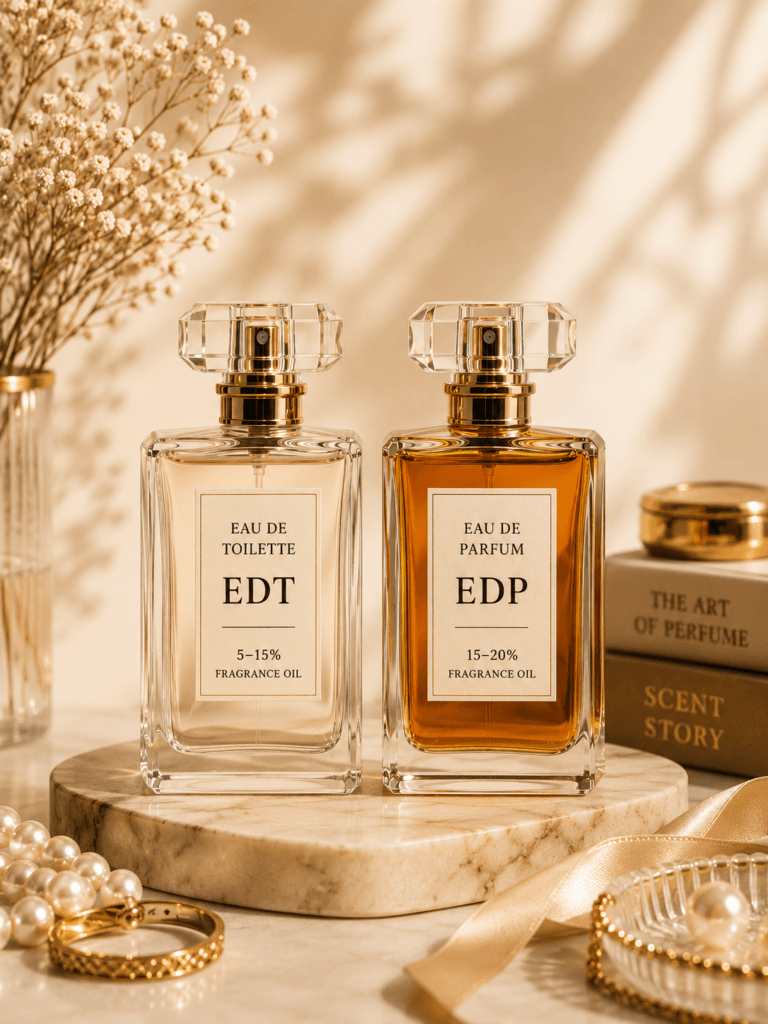
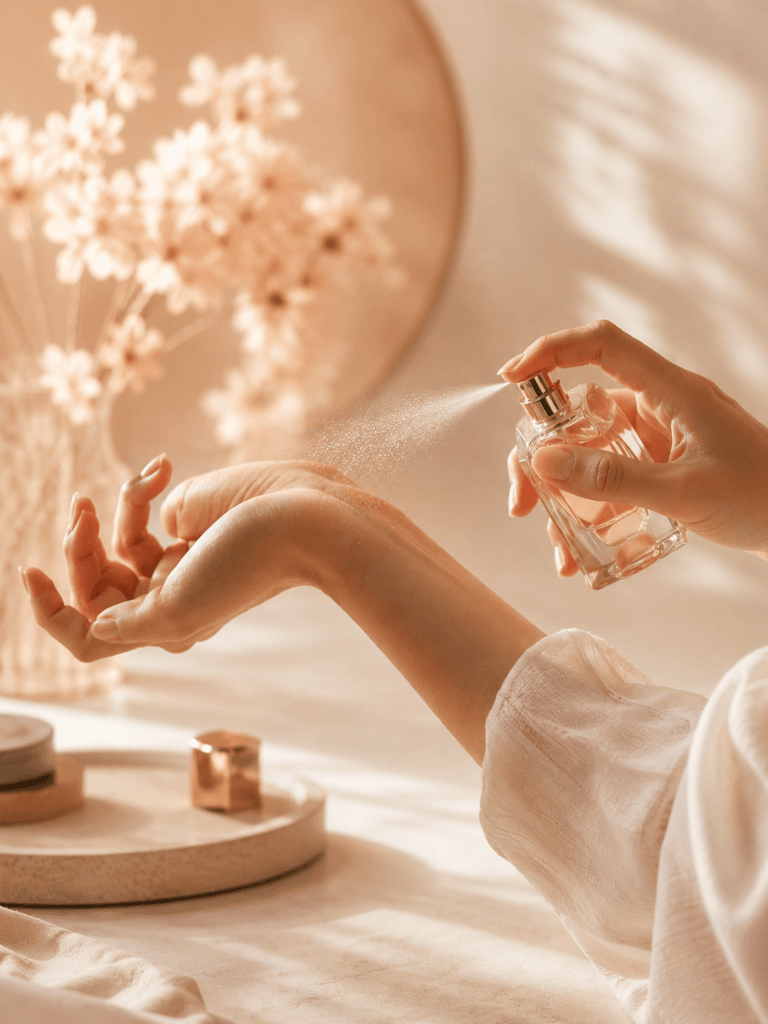
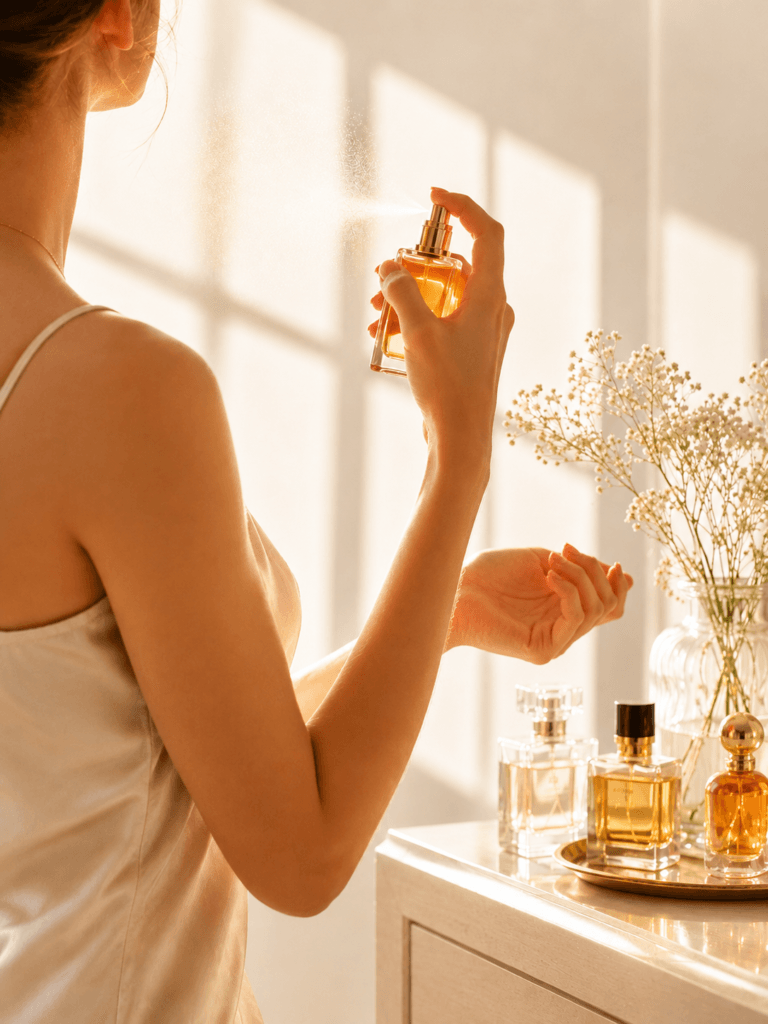
You spray it once, sniff your wrist, and think, “Oh, I love this.” Ten minutes later you’re at the billing counter.
That first spray is doing a lot of heavy lifting it was never meant to carry alone. Most perfumes are designed to make an immediate impression, but liking an opening and liking a perfume are two very different things. The opening is a first date. The dry-down is the marriage.
If you’ve ever bought a bottle that smelled incredible in the store and disappointing by evening, this is why. Testing properly isn’t about being fussy — it’s about actually knowing what you’re buying before you spend the money.
Before You Spray: Know What You’re Testing
A little context before the perfume even touches your skin makes the whole process easier.
Look at the fragrance family. Is it a gourmand, a woody oud, a fresh citrus, a floral? Knowing the family tells you roughly what kind of experience to expect — sweet and cozy, sharp and clean, deep and warm.
Understand the general character, not the marketing copy. Is it loud or quiet? Casual or formal? Built for summer or winter? This isn’t about memorizing facts — it’s about walking in with a rough sense of what you’re about to smell.
Don’t let the listed notes completely dictate your expectations. “Notes” on a bottle are a rough guide, not necessarily a literal ingredient list — plenty of perfumes with “rose” listed will smell nothing like an actual rose. Let your nose have the final word, not the label.
Don’t read 50 reviews before smelling it yourself. It’s tempting, especially with so many “is this worth it?” videos floating around. But a strong opinion planted in your head before you’ve smelled something can absolutely influence what you notice. Read reviews after you test, not before.
Start With a Blotter
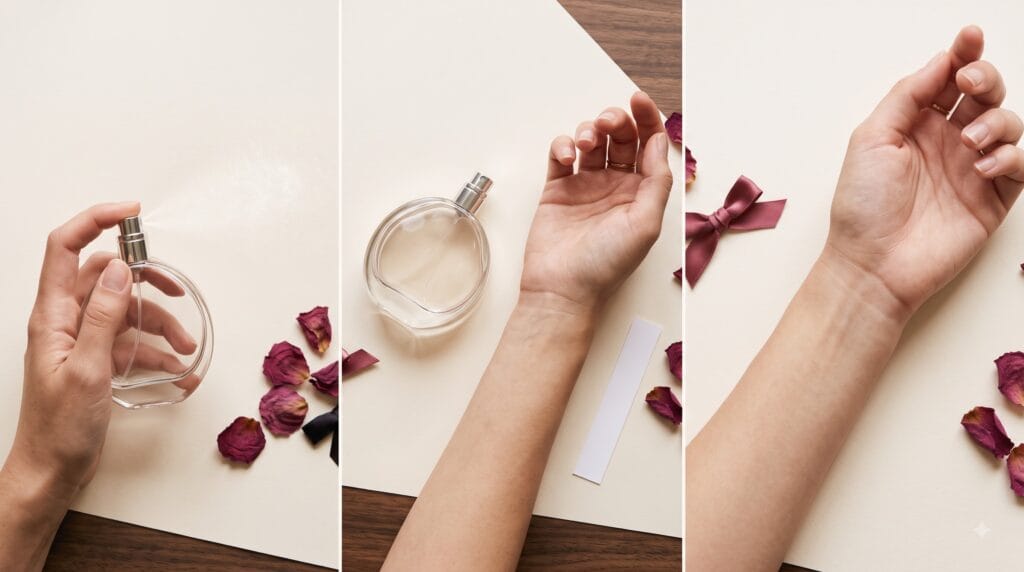
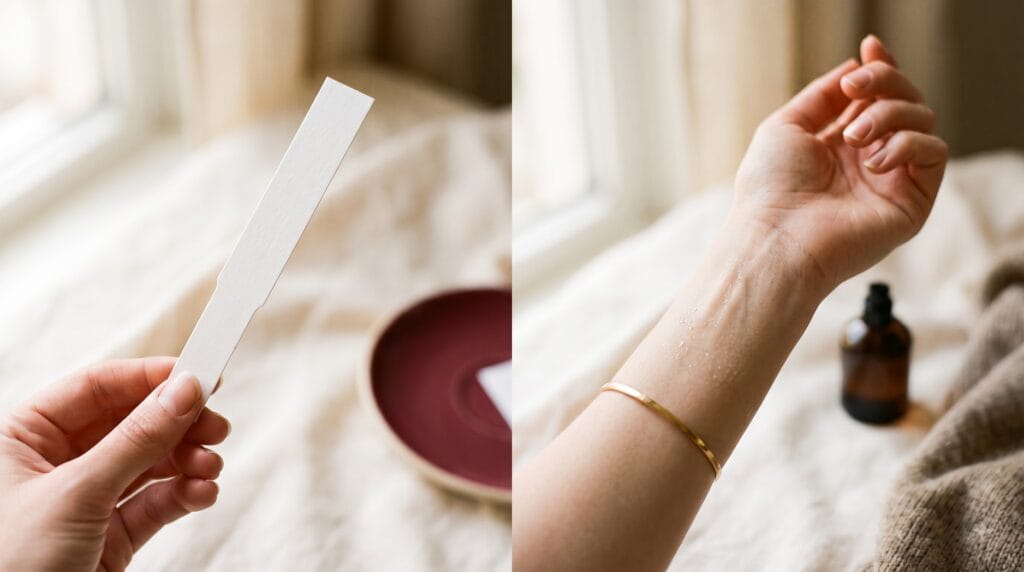
Blotter strips (the little paper strips at fragrance counters) are useful — just not for the reason most people think.
What they’re good for: getting a quick read on the fragrance, deciding if something is worth testing further, and comparing multiple perfumes side by side without putting several fragrances on your skin.
What they can’t tell you: how it actually smells on you. Fragrance interacts with your individual skin — including factors such as skin oils, moisture and temperature — so the same perfume can smell noticeably different on paper versus skin.
So use the blotter to shortlist. Never use it to make the final decision.
Then Test It on Your Skin
Once something survives the blotter round, it earns a spot on your actual skin.
- Where to spray: wrists, inner elbows, or neck are all practical places to test. Choose an area where you can easily smell the fragrance without constantly rubbing or washing it away.
- How many sprays: one or two is enough to judge. You’re testing character, not trying to fill a room.
- Don’t rub your wrists together. This is one of the most common testing mistakes. Rubbing creates friction and can increase evaporation, which may change how the fragrance develops and make it harder to experience the opening as intended.
- Give the perfume space. Don’t sniff it every 30 seconds. Let it breathe and develop naturally.
The Three-Stage Test
This is the actual heart of testing any perfume properly — and it’s the step almost everyone skips.
Stage 1 — The Opening (0–15 minutes)
This is your first impression, and also the least reliable stage to judge a perfume by. You’ll notice the alcohol or carrier smell first in some fragrances, followed by the opening materials — often citrus, fresh accords, herbs, spices or lighter florals.
This stage tells you about the perfume’s initial character, sweetness, freshness or intensity, but it doesn’t necessarily tell you what the fragrance will be like several hours later.
Stage 2 — The Heart (15 minutes–2 hours)
This is where the fragrance starts to settle into its main character. As the most volatile materials fade, other materials become more prominent and the perfume can begin to feel warmer, creamier, sweeter, more floral, woody or spicy.
Pay attention to how it develops. Does it get better? Does something you disliked in the opening disappear? Does a note suddenly become much more prominent than you expected?
And remember: not every modern perfume follows a perfectly neat top-heart-base timeline. Think of these stages as a useful way to understand how a fragrance evolves, rather than a strict formula every perfume has to follow.
Stage 3 — The Dry-Down (2+ hours)
The dry-down is where the fragrance has settled into its later stage, with longer-lasting materials such as musks, woods, amber accords, vanilla and other base materials often becoming more prominent.
This is arguably the most important stage of all, because this is the version of the perfume you’ll spend much of your wearing time with.
Ask yourself honestly: do I still like this once the initial “wow” factor has disappeared?
If you only remember one thing from this section: judge a perfume by its dry-down, not just its opening.
What to Evaluate While Testing
Use this as a simple mental checklist every time you test something new.
| What to Evaluate | Ask Yourself |
|---|---|
| Smell | Do I actually enjoy this? |
| Development | Does it improve or worsen over time? |
| Projection | Can I smell it without putting my nose directly on my skin? |
| Longevity | How long does it stay noticeable? |
| Comfort | Would I want to smell this for hours? |
| Occasion | Where would I realistically wear it? |
| Personality | Does it feel like me? |
Don’t Test Five Perfumes on One Wrist
This is where a lot of testing sessions fall apart — especially at a store counter with too many tempting options.
Your nose can fatigue quickly. After several fragrances, your brain starts having trouble distinguishing between them, and you genuinely can’t tell anymore which scent came from which bottle. This is often referred to as olfactory fatigue.
A good rule: test no more than 2–3 perfumes directly on your skin in one session. If you’re testing several fragrances from blotters, you can compare more, but give yourself breaks before moving on to skin.
And don’t worry about finding a magical “nose reset.” The simplest solution is to take a break, step away from the fragrance counter, and give your nose some time in fresh air.
Test It More Than Once
One testing session is never the full picture. A perfume can smell different depending on:
- Your mood — scent perception is closely tied to memory, emotion and context
- The weather — heat and humidity can make many fragrances feel more noticeable, while cooler conditions can change how they project and develop
- Your nose adapting — the more familiar you are with a scent, the less noticeable it may feel, even if the fragrance itself hasn’t changed
- The occasion — a fragrance you love on a lazy Sunday might feel completely wrong for a work day, or vice versa
If you can, test on more than one day and in more than one setting before committing.
If Possible, Try a Sample or Decant First
This is especially useful if you’re considering an expensive full bottle.
A sample or decant gives you the chance to wear the fragrance for several hours — sometimes several days — without committing to the full bottle.
It’s one thing to enjoy a perfume for 15 minutes in a store. It’s another thing to discover that you still love it after wearing it for eight hours.
And if you don’t? You’ve saved yourself the cost of a full bottle you might never reach for.
Don’t Let Other People’s Opinions Decide for You
Reviews are genuinely useful — for context, for narrowing down a shortlist, and for knowing what to expect going in. But fragrance is one of the most subjective things you can buy.
Labels like “compliment getter,” “beast mode,” or the more, uh, colorful descriptors floating around fragrance communities tell you almost nothing about whether you will like it. Skin, personal taste, memories and associations with certain scents all vary enormously from person to person.
Someone else’s five-star review can be your skin’s worst nightmare — and that’s completely normal.
Use reviews to decide what to test, not what you’re supposed to like.
The Final Buy/Don’t Buy Checklist
Before you swipe your card, run through this:
- ❤️ Do I love the smell?
- ⏳ Do I like the dry-down?
- 👃 Does it work on my skin?
- 🕐 Is the performance — projection and longevity — acceptable to me?
- 👗 Can I imagine actually wearing this — realistically, not aspirationally?
- 💰 Is it worth the price to me?
If most of these are a genuine yes, you’ve found something worth buying.
If you’re talking yourself into “maybe it’ll grow on me” — it probably won’t.
Conclusion
Don’t buy the first impression. Buy the entire fragrance experience.
A perfume is more than a ten-second scene at a store counter. Give it time to develop, wear it on your skin, live with the dry-down, and decide whether you actually want it in your life — not just whether you liked it for five minutes.
Your future self (and your wallet) will thank you.